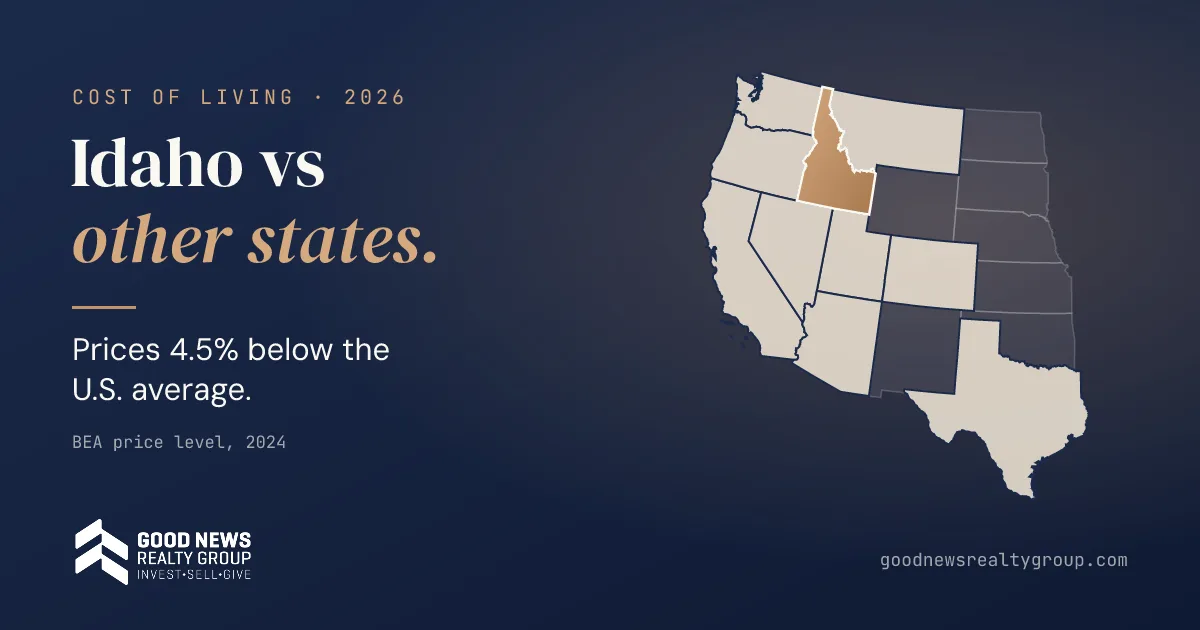
Idaho cost of living vs other states. Where it wins and where it does not.
Idaho next to the U.S. average and nine states people move from: California, Washington, Oregon, Utah, Nevada, Montana, Arizona, Colorado, and Texas. Home prices, taxes, gas, power, car insurance, and overall price level. Every number sourced and dated.
By Johnathan Melin · COO, REALTOR®Published November 5, 2026Last verified November 5, 2026~9 min read
TL;DR · The short answer
Idaho is cheaper than most nearby states overall, but not on every line. Its 2024 price level was 4.5% below the U.S. average and below Washington, Oregon, Nevada, and Utah, just above Montana (BEA), and its electricity and property tax rates are among the lowest in this group. Home prices sit above the national median, gas runs above the U.S. average, and Utah, Colorado, Arizona, Washington, Nevada, and Texas all charge less income tax on wages.
Interactive · Idaho vs your state
Where do you live now?
Idaho cheaperIdaho costs more
13.7%lower in Idaho
Coming from California, everyday prices run about 13.7% lower in Idaho (BEA price level, 2024).
Median home priceIdaho $493,582 · California $752,83734% lower in Idaho
Income taxIdaho 5.3% flat · California 13.3% top8 pts lower in Idaho
Average sales taxIdaho 6.03% · California 8.99%2.96 pts lower in Idaho
Gas, per gallonIdaho $4.44 · California $5.8424% lower in Idaho
Electricity, per kWhIdaho 13.37¢ · California 29.75¢55% lower in Idaho
Car insurance, full coverageIdaho $1,577/yr · California $2,993/yr47% lower in Idaho
Navy bars mean Idaho costs less on that line. Gold bars mean Idaho costs more. Tax rates are compared in percentage points (pts). Sources and dates are in the table and source list below.
Tap a colored state to jump to its row
IdahoPrice level below U.S. averageAbove U.S. averageEqual (Nevada)Number: BEA price level, 2024 (U.S. = 100)
Idaho vs other states. Verified November 5, 2026.
State
Median sale price
Income tax 2026
Avg. sales tax
Property tax rate
Gas (regular)
Electricity
Price level
Idaho
$493,582Zillow $476,754
5.3% flat
6.03%
0.50%
$4.44
13.37¢
95.5
U.S. average
$393,895Zillow $366,157
Varies
7.53%
n/a
$4.10
18.16¢
100.0
California
$752,837Zillow $761,538
1% to 13.3%
8.99%
0.70%
$5.84
29.75¢
110.7
Washington
$590,204Zillow $587,533
None on wages (capital gains 7% to 9.9%)
9.51%
0.75% (0.81%)
$5.13
14.63¢
107.0
Oregon
$504,949Zillow $492,753
4.75% to 9.9%
None
0.81%
$4.74
15.92¢
103.4
Utah
$531,423Zillow $532,920
4.45% flat
7.42%
0.48% (0.52%)
$4.50
13.31¢
98.9
Nevada
$467,158Zillow $440,739
None
8.24%
0.50% (0.47%)
$5.18
12.72¢
100.0
Montana
$518,211Zillow $467,275
4.7% to 5.65%
None
0.61% (0.72%)
$4.23
15.57¢
94.6
Arizona
$437,289Zillow $416,733
2.5% flat
8.52%
0.48%
$4.36
15.05¢
100.7
Colorado
$540,846Zillow $529,013
4.4% flat
7.89%
0.50% (0.48%)
$4.05
17.17¢
103.1
Texas
$329,054Zillow $296,424
None
8.20%
1.40% (1.49%)
$3.58
15.91¢
97.1
How to read this. Median sale price: Redfin, all home types, September 2026, with Zillow's home value index (September 30, 2026) underneath as a second measure. All home types runs lower than single family medians; California's single family median was $899,720 in September 2026 (C.A.R.). Income tax: 2026 rates (Tax Foundation and each state's revenue department; Utah's 4.45% is from SB 60 of 2026, which came after Tax Foundation's table). Sales tax: average combined state and local rate, January 1, 2026 (Tax Foundation). Property tax: effective rate on owner occupied homes, 2024 data (Tax Foundation), with WalletHub's 2026 figure in parentheses where it differs; neither publishes a U.S. rate. Gas: AAA regular, November 5, 2026 (GasBuddy within 2 to 9 cents in every state). Electricity: average residential price, August 2026, preliminary (EIA). Price level: BEA Regional Price Parities, 2024, all items, U.S. = 100. Wyoming, Idaho's sixth neighbor, is not in this table.
Idaho's overall price level was 95.5 in 2024, where the U.S. average is 100 (BEA Regional Price Parities). That is lower than Washington (107.0), Oregon (103.4), Nevada (100.0), and Utah (98.9), and slightly higher than Montana (94.6). Idaho's median sale price was $493,582 in September 2026 (Redfin), below Washington, Oregon, Utah, and Montana but above Nevada. Idaho's flat 5.3% income tax sits in the middle: higher than Utah (4.45%) and higher than Washington and Nevada, which do not tax wages, but lower than Montana (5.65% top rate) and Oregon (9.9% top rate).
Price level is the best single measure for this question. The Bureau of Economic Analysis builds it from rents, goods, utilities, and services in each state, so it captures more than any one bill. On that measure Idaho is the second cheapest state on this page after Montana, and it is cheaper than every West Coast state by a wide margin.
Line by line, the picture is mixed. Washington and Nevada skip the wage income tax but charge more sales tax and, in Nevada's case, much more for gas ($5.18 a gallon on November 5, 2026, versus Idaho's $4.44, AAA). Montana has a lower price level and cheaper gas but a higher top income tax rate. Utah is the closest match to Idaho overall: a similar flat income tax, similar electricity prices, and a slightly higher price level.
Higher or lower than the national average.
Short answer
Mostly lower. Idaho's overall price level was 4.5% below the U.S. average in 2024 (BEA). Residential electricity averaged 13.37 cents per kWh in August 2026 versus 18.16 cents nationally (EIA), and Idaho's effective property tax rate on homes, about 0.50%, is one of the lowest in the country (Tax Foundation). Two costs run higher: the median sale price ($493,582 versus $393,895 nationally, Redfin, September 2026) and gasoline ($4.44 versus $4.10 a gallon, AAA, November 5, 2026). Idaho also taxes groceries at 6%, offset by a $155 per person income tax credit.
Overall price level by state, 2024
Source: Bureau of Economic Analysis, Regional Price Parities, 2024, all items (U.S. = 100). Hover a bar for its value. The same numbers are in the table above.
Lower than average: overall price level (95.5), electricity (about 26% below the U.S. average in August 2026), effective property tax rate, and car insurance by both sources we checked.
Higher than average: the median sale price (about 25% above the U.S. median in September 2026) and gasoline (about 8% above the U.S. average on November 5, 2026).
Different, not higher or lower: groceries. Idaho taxes them at 6% and pays back $155 per person a year through a credit on the state income tax return (Idaho State Tax Commission). Most states on this page exempt groceries; Utah taxes them at a reduced 3%.
Can lower costs offset lower wages?
Short answer
For local wages, it comes out close to even. Idaho's median wage was $47,970 in May 2025, about 6% below the U.S. median of $50,980 (BLS). Idaho's price level was about 4.5% below the U.S. average in 2024 (BEA). Median household income is statistically tied with the nation: $84,234 in Idaho versus $84,780 nationally (Census, ACS 2025). The math works best for households that bring income earned elsewhere, such as remote work.
The wage gap is bigger on the average than on the median. Idaho's mean wage was $61,170 in May 2025 against $69,770 nationally (BLS Occupational Employment and Wage Statistics), because Idaho has fewer very high paying jobs. For a household that keeps a paycheck from a higher wage state, Idaho's lower price level works fully in its favor. For a household switching to Idaho wages, run the numbers on your specific field before you move.
Taxes. Where Idaho lands in the middle.
Short answer
Idaho is a middle of the pack tax state for most households: a flat 5.3% income tax, a 6.03% average sales tax, and a low effective property tax rate of about 0.50%. It wins clearly against California and Oregon on income tax, and against Washington, Nevada, Arizona, and Texas on sales tax.
Three details change the comparison for some households:
Washington taxes capital gains. There is no wage income tax, but long term capital gains above the annual deduction are taxed at 7%, rising to 9.9% on gains over $1 million (Washington Department of Revenue). If you plan to sell stock or a business, that matters.
Texas trades income tax for property tax. No income tax, but an effective property tax rate of about 1.40%, nearly three times Idaho's (Tax Foundation).
Idaho's homeowner's exemption is large. It removes half of a primary home's assessed value, up to $125,000, from property tax. You must file with the county assessor by the last county business day of December to get it for that tax year. Our Idaho property tax guide walks through it.
Car insurance by state.
Short answer
Both sources we checked put Idaho below the national figure. Experian's 2026 average for full coverage in Idaho was $1,577 a year versus $2,912 nationally. NerdWallet's median quote was $1,999 versus $2,357. The two sources disagree on several states, including California, so compare real quotes for your own vehicle, record, and ZIP code.
State
Experian average
NerdWallet median quote
Idaho
$1,577
$1,999
U.S. average
$2,912
$2,357
California
$2,993
$1,884
Washington
$2,867
$2,323
Oregon
$2,513
$2,207
Utah
$2,457
$2,435
Nevada
$3,732
$3,497
Montana
$2,260
$2,879
Arizona
$2,521
$2,942
Colorado
$2,712
$3,283
Texas
$2,897
$3,640
Experian: average of full coverage policies sold on its marketplace in the 12 months to September 2026. NerdWallet: median full coverage quotes for a sample driver with good credit and a clean record, 2026. They measure different things, which is why some states move a lot between columns.
How Idaho costs changed in recent years.
Short answer
Home prices drove most of the change. Idaho's FHFA purchase-only house price index rose about 87% from mid-2019 to mid-2026 and about 25% over the last five years, and it was up 3.6% in the year to the second quarter of 2026 (our math on FHFA index values). Idaho's overall price level also moved closer to the national average, from 7.8% below in 2023 to 4.5% below in 2024 (BEA).
Most of the rise came before mid-2022: the index climbed about 77% from mid-2019 to its mid-2022 peak. Since that peak, Idaho's index has grown slowly; in the second quarter of 2026 it was about 5.6% above its 2022 high (FHFA House Price Index). Mortgage rates are the other big monthly cost. The 30 year fixed average was 7.18% for the week of November 5, 2026 (Freddie Mac).
Sometimes, but not automatically. A lower price per acre can come with costs a city lot does not have: a private well, a septic system, propane or other heating fuel, and longer drives for work, groceries, and medical care. Water rights and well depth can change what a parcel is worth. Check those items for the specific property before you compare it with a home in town.
Good News Realty Group is committed to the principles of the Fair Housing Act. We do not discriminate based on race, color, religion, national origin, sex, familial status, disability, or any other protected class. All buyers are free to consider any neighborhood, price point, or property. Equal Housing Opportunity.
Sources cited in this article
Redfin housing market pages (national and each state's /state/<name>/housing-market page). Median sale price, all home types, September 2026.
Every number on this page was read from the source on November 5, 2026, the "Last verified" date above. Where two sources measure the same thing and disagree, we show both. Home prices, gas, and electricity move monthly; tax rates move by legislative session. We refresh this page every quarter.
Common questions
Idaho vs other states. Common questions.
Idaho's overall price level was 95.5 in 2024, where the U.S. average is 100 (BEA Regional Price Parities). That is lower than Washington (107.0), Oregon (103.4), Nevada (100.0), and Utah (98.9), and slightly higher than Montana (94.6). Idaho's median sale price was $493,582 in September 2026 (Redfin), below Washington, Oregon, Utah, and Montana but above Nevada. Idaho's flat 5.3% income tax sits in the middle: higher than Utah (4.45%) and higher than Washington and Nevada, which do not tax wages, but lower than Montana (5.65% top rate) and Oregon (9.9% top rate).
Mostly lower. Idaho's overall price level was 4.5% below the U.S. average in 2024 (BEA). Residential electricity averaged 13.37 cents per kWh in August 2026 versus 18.16 cents nationally (EIA), and Idaho's effective property tax rate on homes, about 0.50%, is one of the lowest in the country (Tax Foundation). Two costs run higher: the median sale price ($493,582 versus $393,895 nationally, Redfin, September 2026) and gasoline ($4.44 versus $4.10 a gallon, AAA, November 5, 2026). Idaho also taxes groceries at 6%, offset by a $155 per person income tax credit.
For local wages, it comes out close to even. Idaho's median wage was $47,970 in May 2025, about 6% below the U.S. median of $50,980 (BLS). Idaho's price level was about 4.5% below the U.S. average in 2024 (BEA). Median household income is statistically tied with the nation: $84,234 in Idaho versus $84,780 nationally (Census, ACS 2025). The math works best for households that bring income earned elsewhere, such as remote work.
Home prices drove most of the change. Idaho's FHFA purchase-only house price index rose about 87% from mid-2019 to mid-2026 and about 25% over the last five years, and it was up 3.6% in the year to the second quarter of 2026 (our math on FHFA index values). Idaho's overall price level also moved closer to the national average, from 7.8% below in 2023 to 4.5% below in 2024 (BEA).
Sometimes, but not automatically. A lower price per acre can come with costs a city lot does not have: a private well, a septic system, propane or other heating fuel, and longer drives for work, groceries, and medical care. Water rights and well depth can change what a parcel is worth. Check those items for the specific property before you compare it with a home in town.
It depends on how you earn and spend. Washington and Nevada do not tax wages, but their average combined sales tax rates are higher: 9.51% and 8.24% versus Idaho's 6.03% (Tax Foundation, January 2026). Oregon has no sales tax but a top income tax rate of 9.9%. Idaho taxes wages at a flat 5.3%, has a low effective property tax rate of about 0.50%, and taxes groceries with a $155 per person credit.
Both sources we checked put Idaho below the national figure. Experian's 2026 average for full coverage in Idaho was $1,577 a year versus $2,912 nationally. NerdWallet's median quote was $1,999 versus $2,357. The two sources disagree on several states, including California, so compare real quotes for your own vehicle, record, and ZIP code.
On overall price level, yes. Idaho was 95.5 in 2024 versus 98.9 for Utah and 103.1 for Colorado (BEA, U.S. = 100). Idaho's median sale price of $493,582 was below Utah ($531,423) and Colorado ($540,846) in September 2026 (Redfin). Utah (4.45%) and Colorado (4.4%) have lower flat income tax rates than Idaho's 5.3%, and Colorado's gas was cheaper on November 5, 2026 ($4.05 versus $4.44, AAA).
Tell us where you live now, your move date, and your budget. We will compare your current costs with the Treasure Valley city that fits, line by line, before you write a single offer.
Buyer-agent compensation is fully negotiable and not set by Good News Realty Group, NAR, or the MLS. We walk you through how it works on every home before you tour.